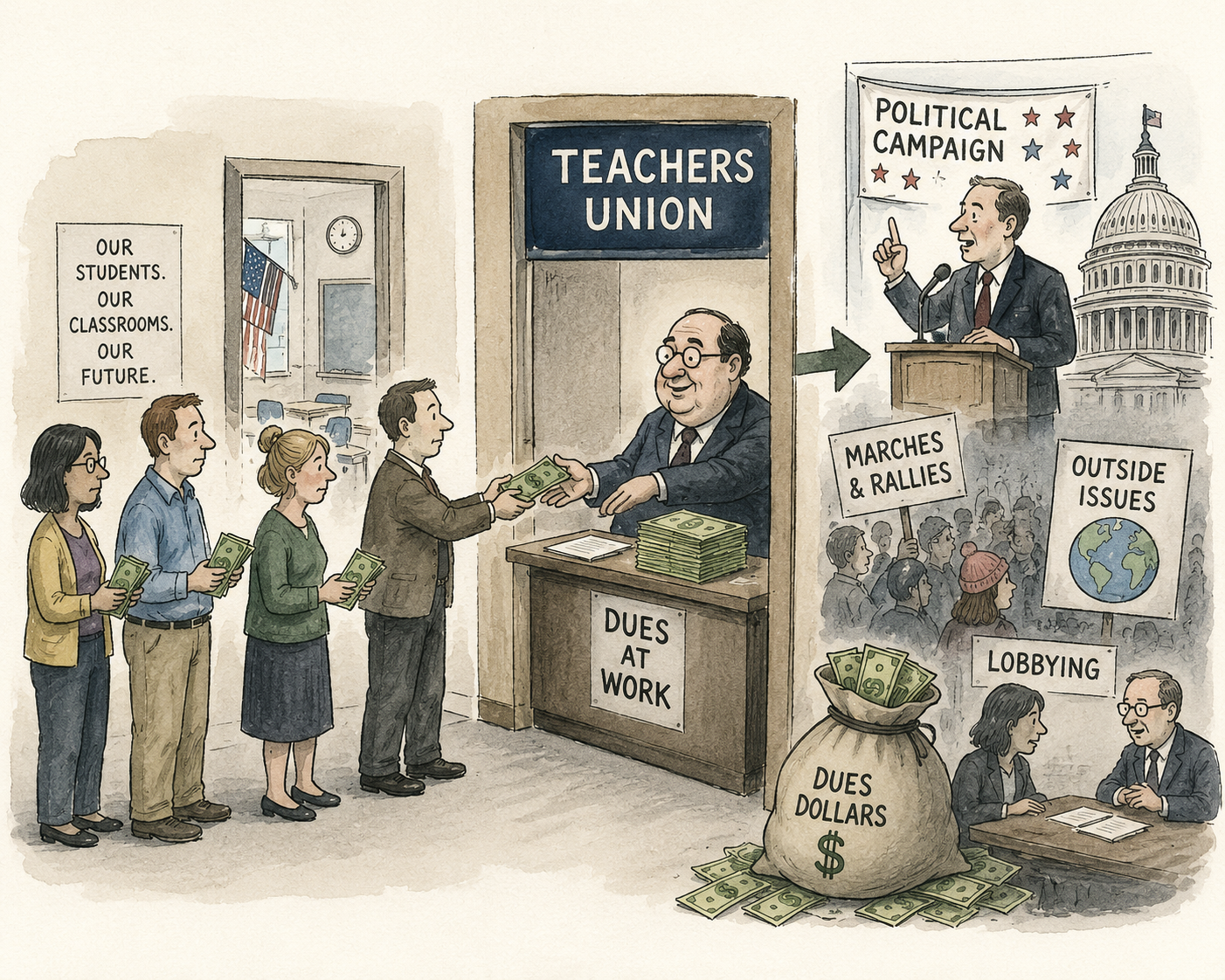
For decades, teachers’ unions justified their political influence with a straightforward argument: they existed to advocate for better wages, better working conditions, and better educational outcomes. That is an agenda most Americans support.
The National Education Association’s 2026 Representative Assembly suggested a different set of priorities.
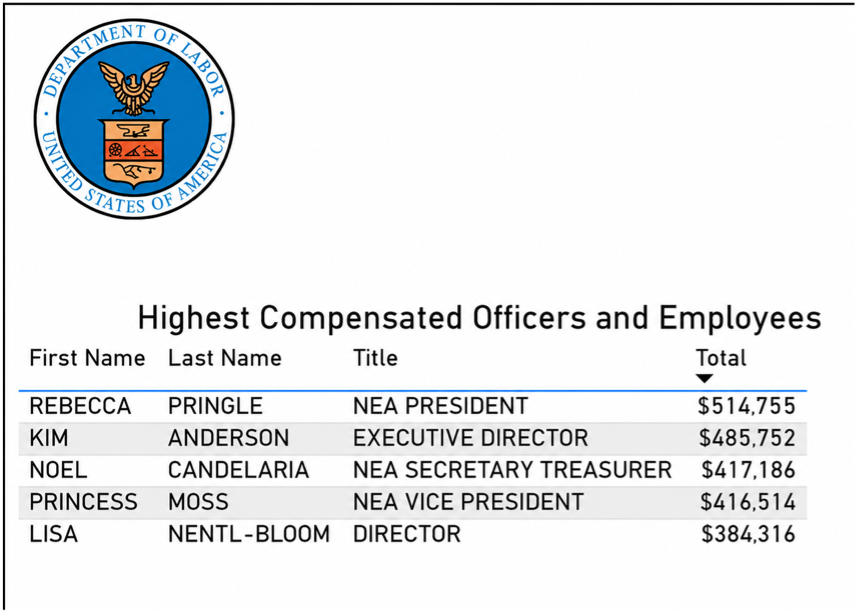
Fig 1. Most teachers are unaware of the salaries they pay from their dues for National NEA union officials.
The assembly approved dues-supported initiatives addressing immigration enforcement, labor strikes, Middle East policy, DEI programs, land acknowledgments and political organizing. This represents a growing list of causes with little direct connection to teacher pay, classroom conditions or student achievement.
One proposal called for organizing a national march on Washington aimed at impeaching and removing President Donald Trump before the 2026 midterm elections, at an estimated cost of more than $5.2 million.
Whatever one thinks of these causes, they are not collective bargaining. They are national political activism, funded in part by educators who joined a professional organization expecting it to represent their profession.
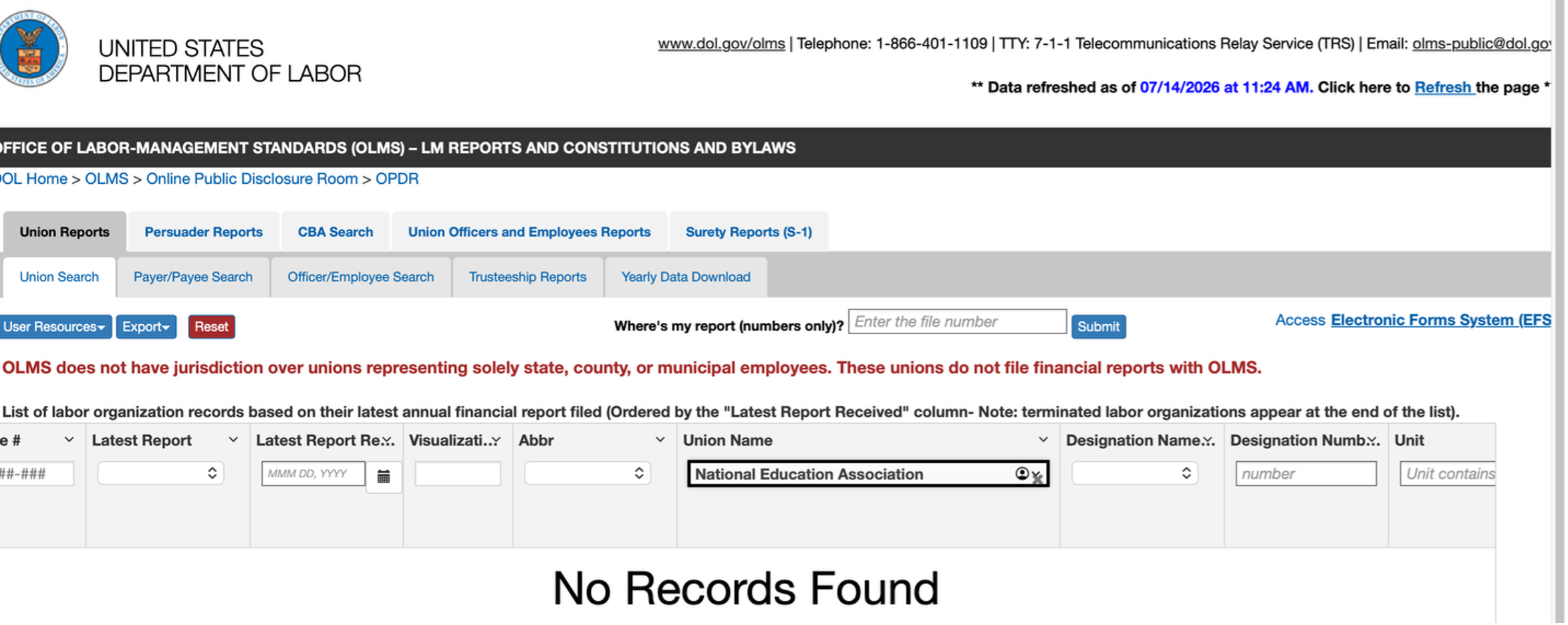
Teachers fund this activity, yet many have limited ability to see how their money is spent. The NEA files financial disclosures required under federal law but hides the files under a name that makes it hard for teachers or members of the public to find. A simple search for the unions name results in, “No records found.”
Fig. 2 Search results for the National Education Association are hidden by the name game.
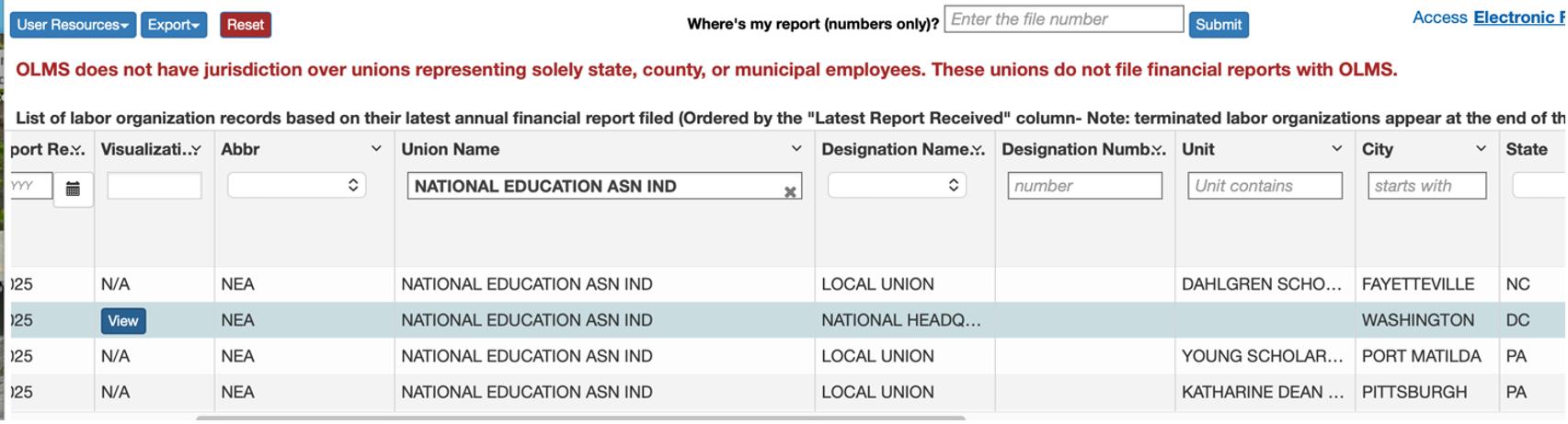
Only after you search, “NATIONAL EDUCATION ASN IND” will you be able to view the file.
Fig. 3 Without knowing how they are listed it is overly burdensome to find.
To make matter worse numerous state and local affiliates operate with far less transparency and are not required to file LM 2 files leaving teachers and the public in the dark. Many members have little insight into how their dues are allocated or where outside funding originates.
The Department of Labor proposed a remedy in 2019. Under the proposed rule, public-sector intermediate union bodies subordinate to national organizations would file detailed annual financial reports like those required of private-sector unions.
That change would give teachers, parents, and taxpayers greater visibility into how dues are spent, where political spending occurs and how much money flows through organizations that frequently rely on taxpayer-funded facilities, payroll deduction systems, release time and administrative support.
Some states have acted. Florida prohibits payroll deduction of union dues for teachers. Connecticut requires unions to provide members a copy of their financial reports, a requirement enforced inconsistently for years, until public scrutinyand litigation by the Fairness Center pushed the state Department of Labor to begin enforcing it.
Transparency of this kind should not be controversial.
The concern is sharpened by where student outcomes stand. According to the most recent National Assessment of Educational Progress, reading and math scores remain below pre-pandemic levels nationwide.
Chronic absenteeism continues to burden schools. Enrollment has declined in many districts even as administrative staffing has expanded, and employers increasingly report that graduates lack basic academic and workplace skills.
Against that backdrop, the decision to expand into an all-purpose political agenda, rather than concentrate on academic recovery and the teaching profession itself, is difficult to reconcile with the union’s stated mission.
The same pattern appears in the unions’ response to the new federal education tax credit. Leaders of both major teachers’ unions have signaled that Democratic governors who opt their states into the program risk losing endorsements and campaign support.
The framing does not match the mechanics. A governor’s decision not to opt in does not prevent residents from participating; it simply directs the benefit, and the scholarships it funds for supplies, tutoring and tuition, to students in other states.
The unions have described this as an existential threat, but what it actually offers is access to educational resources that affluent families already secure on their own.
Wealthier families buy homes in strong school districts, pay for tutoring or private tuition, and relocate when a school fails their child. Many working-class families cannot. When union leaders oppose these alternatives, the practical effect is to tell children in struggling schools that they must stay put while families with means exercise options unavailable to everyone else.
The priority becomes protecting a system rather than serving the students inside it.
Most teachers did not sign up for this. The majority entered the profession to educate children and serve their communities, not to fund political marches or ideological campaigns. Teachers deserve representation focused on their profession.
Parents and taxpayers deserve transparency and schools focused on learning.
Local school boards have a role to play. Rather than accepting general assurances, they should request long-term data on enrollment, staffing levels, academic achievement, attendance, and employee leave utilization.
Reviewing these trends over 10, 15, or 20 years reveals whether growing administrative structures are producing better results, whether resources are aligned with student needs and whether district priorities reflect educational outcomes rather than institutional interests.
Examined together, that data strengthen governance and refocuses attention where it belongs: student achievement and responsible stewardship of taxpayer dollars.
The NEA’s 2026 agenda offered a revealing look into the priorities of America’s most powerful teachers’ union. The organization that once fought primarily for teachers is increasingly fighting for a much broader agenda.
The open question now is whether teachers, parents, taxpayers, and school board members will refocus that fight on students.
Frank Ricci is a fellow at Yankee Institute, past union president for New Haven Fire Fighters, and a retired battalion chief. He was the lead plaintiff in the landmark Supreme Court case Ricci v. DeStefano. He is the author of Command Presence.