
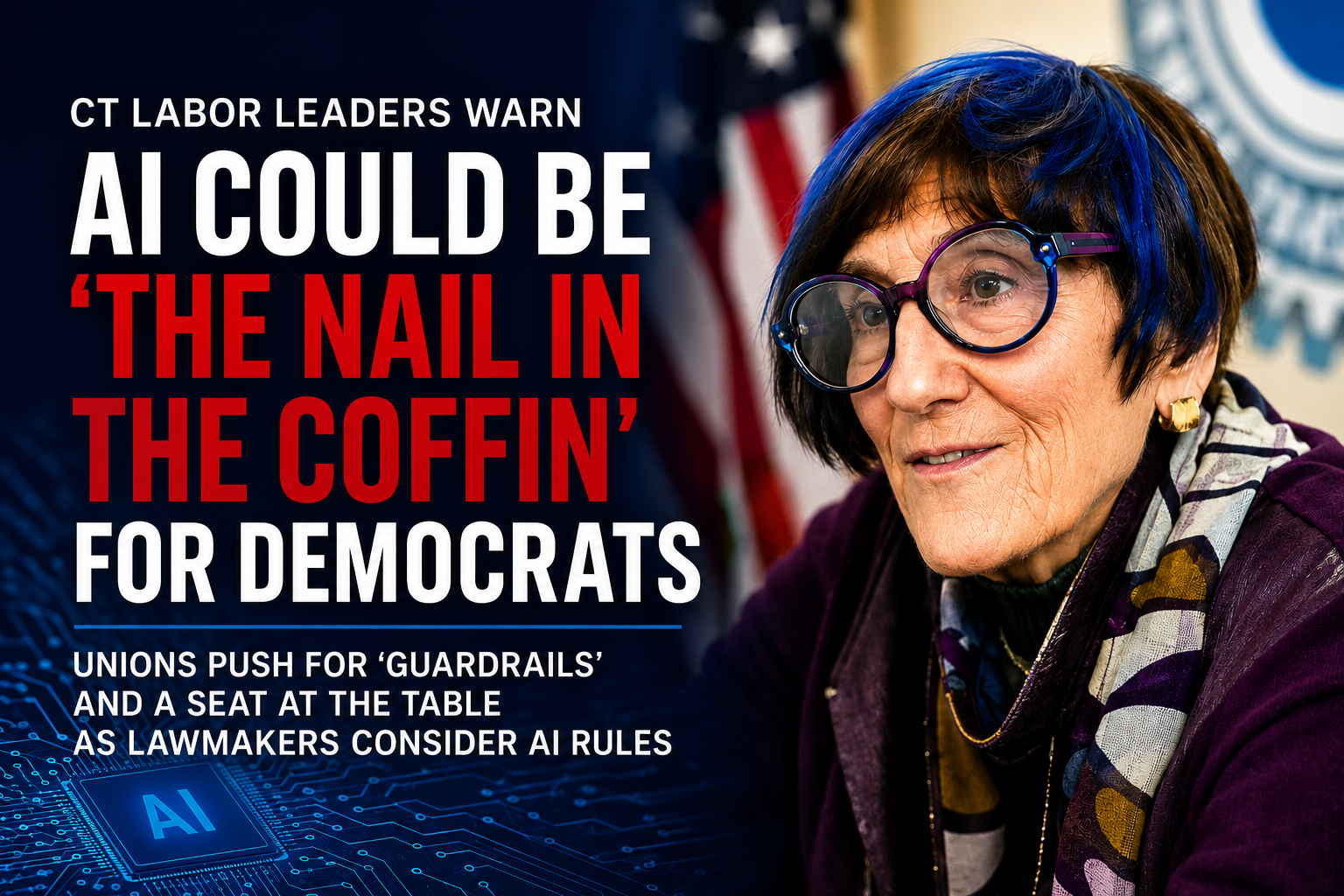
Organized labor has found its next target: artificial intelligence.
At a June 1 trade roundtable hosted by U.S. Rep. Rosa DeLauro in New Haven, Connecticut labor leaders warned that AI threatens workers and demands new government “guardrails.” But the discussion revealed something beyond concern: unions want a hand in writing the rules for how employers use it.
The event, held at the Manufacturing and Technical Community Hub (MATCH), brought together DeLauro, Wisconsin Congressman Mark Pocan, Connecticut labor leaders, manufacturers, state economic development officials and Public Citizen, a progressive advocacy group. The official topic was trade policy. Before long, the conversation shifted to artificial intelligence.
Connecticut AFL-CIO President Ed Hawthorne framed the issue in pointed terms.
“If the Democratic Party does not get out ahead of AI, it’s when the Democratic Party dies,” he said. “It’ll be the nail in the coffin, because we are the party of the workers, and if we are going to just sit back and let the tech industry and their money buy elections and not push back on that, we will no longer be the party of the workers, and that’s when we lose.”
Hawthorne also described AI as “the new NAFTA,” a warning that artificial intelligence could displace workers in ways similar to past trade disruptions. Those concerns are not baseless. AI will disrupt labor markets. Some jobs will disappear, others will change, and new occupations will emerge. Few serious observers believe the economy will be left untouched.
But Hawthorne’s sharpest warning was political rather than economic. He was not simply saying AI could eliminate jobs. He was saying that if Democrats fail to satisfy organized labor’s demands on AI, they forfeit their claim to be the party of workers. That is a different kind of argument, and worth noting as such.
The real question is how policymakers respond. At the roundtable, the answer increasingly centered on one word: “guardrails.”
Participants repeatedly called for guardrails around AI and automation. In practice, that meant stronger worker input requirements, advance notice when AI is used in employment decisions, human oversight, appeal rights, bias testing and an expanded government role in governing how AI systems are introduced in the workplace.
Some of that is defensible. Few Americans want hiring decisions or workplace discipline delegated to opaque systems with no accountability. Protections against deceptive deepfakes and discriminatory bias deserve serious consideration. But the discussion ranged well beyond basic safeguards. It sounded less like a targeted debate over genuine AI risks and more like organized labor ensuring no major workplace technology advances without union-approved conditions attached.
The day after the roundtable, Hawthorne described it on social media as a conversation about building a “worker-centered vision for international trade” and thanked DeLauro and Pocan for “fighting to ensure that workers have a seat at the table when the future of our economy is being decided.” Wayne McCarthy, president of International Association of Machinists Local Lodge 700, replied that the meeting covered tariffs, trade and “the threat of AI on the working class,” adding: “Thankfully, we have the ear of Rosa and Representative Pocan from Wisconsin, as they work on legislation to address our concerns.”
The intent was plain: labor leaders do not merely want to warn lawmakers about AI. They want influence over how employers deploy it.
That is where the pitch starts sounding less like protection and more like institutional self-preservation. Organizations built around collective bargaining, job classifications and established workplace procedures are not neutral referees when a technology threatens to make those structures less relevant. Their preferred response — more rules, more oversight, a guaranteed seat at the table — is exactly what one would expect from institutions whose leverage depends on those rules remaining in place.
That may serve union interests. Whether it serves Connecticut’s competitiveness is a harder question.
A recent Manhattan Institute report on AI policy offered a more measured framework, warning that policy “must not be overly broad or restrictive” and should target genuine risks: national security, cybercrime, deepfakes, high-stakes automated decisions, without burdening the broader technology with gratuitous regulation. The report noted that many AI applications are simply more sophisticated versions of existing software tools, and that treating them otherwise distorts the policy debate.
That distinction matters. The question is not whether AI warrants any oversight — it does — but whether fear of disruption becomes a justification for letting institutions with a direct interest in preserving existing workplace arrangements define the rules for a technology whose value may come precisely from changing them.
Disruption is not, by itself, evidence that innovation should be slowed or that organized labor should sit at the center of every deployment decision. The harder task for policymakers is distinguishing between regulations that protect workers from genuine harms and regulations that protect incumbent institutions from inconvenient change.


Kim Libera
June 15, 2026 @ 4:27 pm
We’ve been thru the woke fad & the climate fad please let us not try the GOP version of a fad namely AI. We already have some. The danger with AI is that it will put people out of work. How will we sustain society? Individuals pay taxes; robots don’t. Next the real threat is it leaves us humans as a blank slate to be molded by the body politic-in this case the corporate elite who generally runs the country. Their soul aim is eliminating labor costs. But the damage leaves people w/o the ability to think. It just pushes a button. Or as we have seen this century, whatever the elites say, the people are doormats & will just absorb & be molded. We have the calculator but we still have to go thru arithmetic, learn how to measure, look for patterns. We went thru typing & now typewriters don’t exist as the much better keyboard design & a computer increase production. Kids have to learn how to write term papers. They have to learn to read, speak a language. Now think of this. Forget interviewing for a job. The AI will select based on how the powers that be want you to be defined. In other words, the dumber you the more you are a blank slate to be molded.