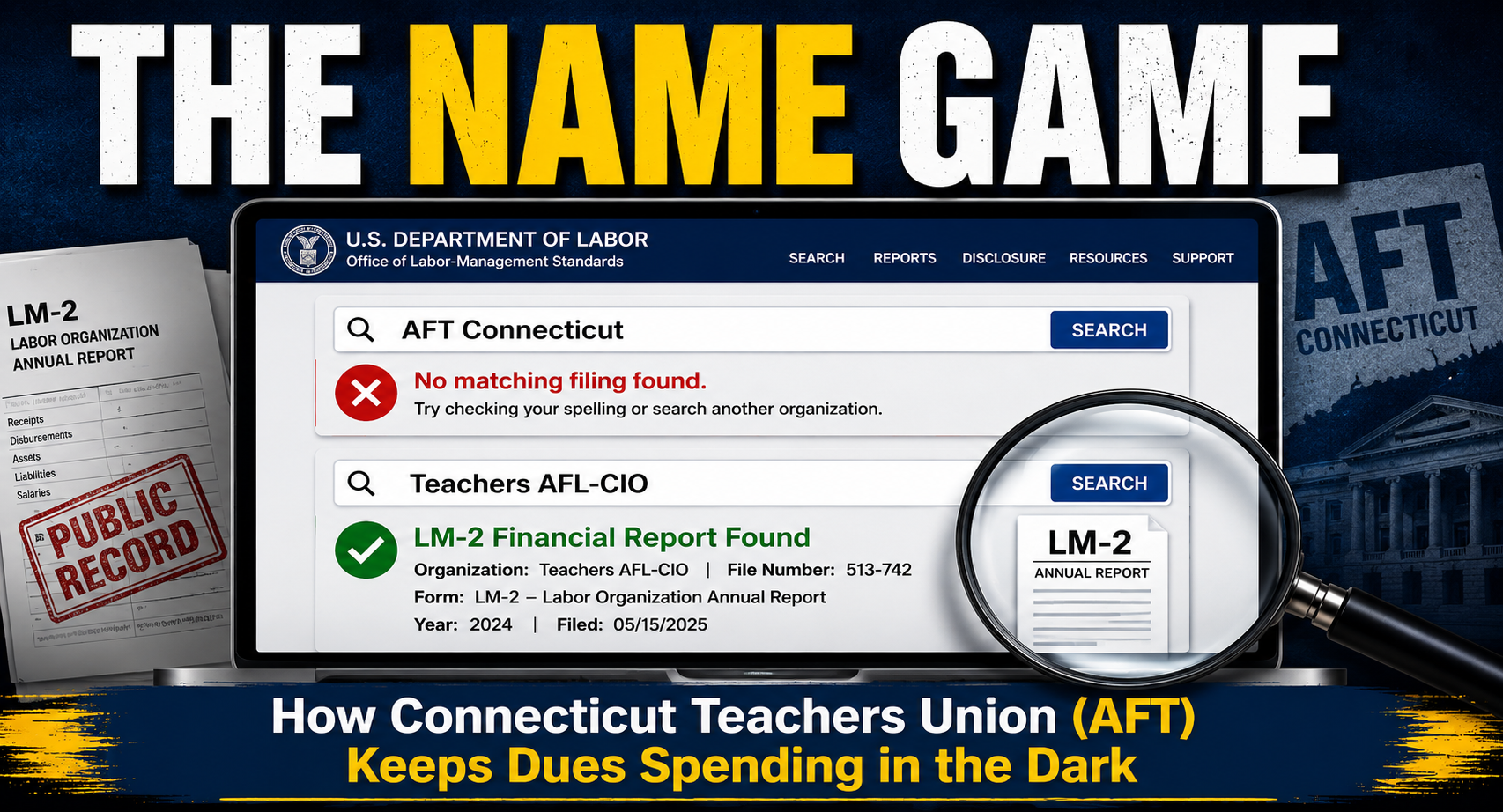
Every year, more than 30,000 Connecticut educators’ hand over a portion of their paycheck to the American Federation of Teachers Connecticut. Most never see a detailed accounting of where that money goes. That isn’t an accident, and it has persisted despite state and federal laws written specifically to prevent it.
As a former union president and treasurer with more than sixteen years of union leadership experience, my perspective is grounded not just in principle but in practice. I know firsthand the important role unions can play in protecting workers and advocating for better conditions. I also know how large organizations change over time.
I spent sixteen years handling union finances, negotiating contracts, and answering directly to members. The overwhelming majority of union leaders are honest people doing the right thing. But accountability systems are not built for the honest majority; they are built for the small minority who abuse positions of trust. Transparency exists not because we expect misconduct, but because history shows that power exercised without oversight eventually invites it.
What begins as a mission to empower working people can gradually become a mission to preserve the institution itself. The danger is not merely corruption. It is bureaucracy. Like government agencies that grow increasingly focused on sustaining themselves, unions can drift toward protecting leadership, preserving revenue streams and maintaining organizational power rather than serving the members whose dues fund the operation. Internal transparency becomes an afterthought. In some cases, insulation from scrutiny becomes a feature rather than a flaw.
That reality helps explain why Congress passed the Labor-Management Reporting and Disclosure Act of 1959 (LMRDA), Public Law 86-257. Enacted by a bipartisan Congress in the wake of well-publicized union corruption scandals, the law was designed to protect rank-and-file workers by requiring financial transparency and accountability from labor organizations. Its centerpiece was the Form LM-2, a detailed annual financial report that larger unions must file with the U.S. Department of Labor, disclosing assets, liabilities, salaries, receipts, expenditures, loans, political spending, and significant disbursements. Filing false information carries criminal penalties under federal law.
The promise was straightforward: union members should always be able to see how their dues are spent.
For decades, that promise existed more on paper than in practice. The reports are difficult to locate, difficult to navigate, and often hundreds of pages long. Most union members do not know they exist. A transparency system that ordinary workers cannot access or understand is not truly transparent.
The consequences are real. In fiscal year 2025, the U.S. Department of Labor’s Office of Labor-Management Standards completed 198 criminal investigations involving embezzlement, fraud, falsified records, wire fraud, and other violations of federal labor law, union officers and employees accused of stealing from the very workers they were elected to represent. Those cases represent only the misconduct serious enough to trigger a federal investigation. Countless questionable expenditures, ethical violations, improper reimbursements, and abuses are quietly resolved through repayments, resignations or internal settlements that leave members unaware anything occurred.
The purpose of transparency is not to assume wrongdoing. It is to make wrongdoing harder to hide.
The Name Game
On AFT Connecticut’s federal LM-2 filing, the “Affiliation or Organization Name” is not listed as AFT Connecticut. It appears as “Teachers AFL-CIO.” The familiar name appears only within the mailing address section of the filing.
Figure 1 — AFT Connecticut’s Form LM-2 (File No. 513-742). Showing the name of the union is not the normal name a teacher would look for.
This may satisfy a technical filing requirement, but it undermines transparency. The average member searching federal databases is unlikely to find a filing that exists under a different name.
Across the country, unions frequently file under names that differ from the names members actually use, reports that are technically public while remaining practically invisible.
Following the Money
For members who do locate the filing, the numbers offer a revealing look at how dues are allocated.
According to AFT Connecticut’s most recent LM-2 filing, the union president received compensation of approximately $181,720. The chief of staff received $169,261. A director of organizing received $163,803. Multiple field representatives earned compensation exceeding $150,000 annually before accounting for benefits and other expenses.

Figures 2, 2A, 2B — Highest-compensated officers and employees reported on AFT Connecticut’s LM-2 filing.
These figures are not evidence of wrongdoing. They are evidence that union leadership positions can be highly compensated, and that members have a legitimate interest in understanding how their dues are allocated.
The spending extends well beyond salaries. Among the largest disbursements reported were more than $633,000 paid to a single law firm, approximately $322,000 paid to another labor organization, and substantial expenditures categorized as administration, political activities, lobbying, utilities, overhead, and other operational costs.


Figure 3 —Largest organizational disbursements reported by AFT Connecticut.


Figure 4 — Total expenditures by category for AFT Connecticut.
None of these expenditures are inherently improper. The problem is that for decades most members had little realistic ability to review, understand, or evaluate them. The issue is not whether members agree with every line item. It is whether they can see those expenditures in the first place.
That is beginning to change.
The Most Significant Transparency Reform in Two Decades
In March 2026, the Office of Labor-Management Standards launched a new LM reporting data visualization tool, the most significant modernization of union financial transparency in more than twenty years. The tool transforms dense LM-2 filings into searchable charts, interactive graphics, and easy-to-understand summaries. Information that once required hours of review can now be accessed in minutes.
OLMS Director Elisabeth Messenger captured the significance: “When union members can clearly see how their dues are being spent, they may notice irregularities that could indicate union officers or employees may be misspending the members’ hard-earned dues.
We encourage any union member that sees anything out of the ordinary with their union’s finances to contact the Office of Labor-Management Standards.”
That statement reflects a fundamental truth. The most effective watchdog over union finances is not Washington. It is the rank-and-file member.
Yankee Institute has been among the leading voices for meaningful union financial transparency, submitting comments during the federal LM-2 modernization process, providing testimony before the U.S. House Committee on Education and the Workforce and presenting concerns to the U.S. Department of Labor in 2025. Two of our central recommendations were simple: union members should be able to find their organization under the name they actually know, and financial information should be presented in a format ordinary people can understand. Both principles are reflected in the new federal tools.
The U.S. DOL page for Connecticut AFT contains easy to understand public pages on overview, finances, membership, multi-year comparisons, itemized disbursements and officer and employee compensation.
Connecticut’s Forgotten Transparency Law
Federal reporting requirements tell only part of the story. Many local teachers’ unions are too small to meet federal filing thresholds and therefore never submit an LM-2 to Washington.
Connecticut addressed that gap nearly seventy years ago. Connecticut General Statute §31-77, enacted in 1957, requires labor organizations with twenty-five or more members to file annual financial reports with the state Labor Commissioner and make those reports available to members.
For decades, the law sat largely dormant. Many unions stopped filing or never filed at all. The Connecticut Department of Labor accumulated virtually no records and enforcement was nonexistent.
That is changing. Yankee Institute helped bring public attention to the issue through research, public education, and testimony before the Connecticut General Assembly. Working alongside state legislators, we helped expose the fact that a transparency law on the books since 1957 was effectively being ignored.
In February 2026, the Fairness Center filed Bilodeau & Ormond v. AFSCME Local 391 & 4Cs on behalf of public employees seeking access to financial records that Connecticut law already required unions to provide. The Connecticut Department of Labor is now enforcing the statute and requesting documents from unions that do not file LM-2s with the federal government.
What Every Teacher Should Ask For
The practical lesson is straightforward: do not assume transparency exists simply because a law requires it.
Every union member has the right to request a copy of their union’s financial records — the annual profit-and-loss statement, balance sheet and year-end summaries for every union-issued credit card. Pay particular attention to expenditures for travel, lodging, meals, conferences, consulting contracts, legal services and political activities.
Credit-card records are especially worth reviewing because they often capture spending before it is filtered through accounting software and recategorized into broad budget classifications. What ultimately appears as an administrative expense may have originated as restaurant bills, hotel stays or other purchases that members would reasonably want to evaluate for themselves.
Transparency is not an act of hostility. It is the foundation of accountability.
The Lights Are Coming On

For decades, union financial disclosure operated more as a legal formality than a meaningful accountability system. Reports were technically public but practically inaccessible. Filing requirements existed, but enforcement was sporadic.
That era is ending. The U.S. Department of Labor’s new visualization tools make federal filings understandable for ordinary members. Connecticut’s long-dormant transparency law is receiving renewed enforcement. Court challenges are restoring obligations that had been quietly ignored. And workers themselves are beginning to ask questions.
The issue ultimately transcends AFT Connecticut or any single labor organization. It is about whether workers have meaningful oversight of institutions that exist in their name and operate with their money. The strongest unions should welcome that scrutiny, honest leaders have nothing to hide, and organizations funded by workers should never fear those workers examining the books.
The name game only works in the dark. For the first time in a generation, the lights are on. In the coming weeks, the Yankee Institute will be publishing breakdowns of individual Connecticut unions with direct links to their U.S. Department of Labor pages.
Frank Ricci is a Fellow at Yankee Institute, past union president for New Haven Fire Fighters and a retired battalion chief. He was the lead plaintiff in the landmark Supreme Court case Ricci v. DeStefano. He is the author of Command Presence.