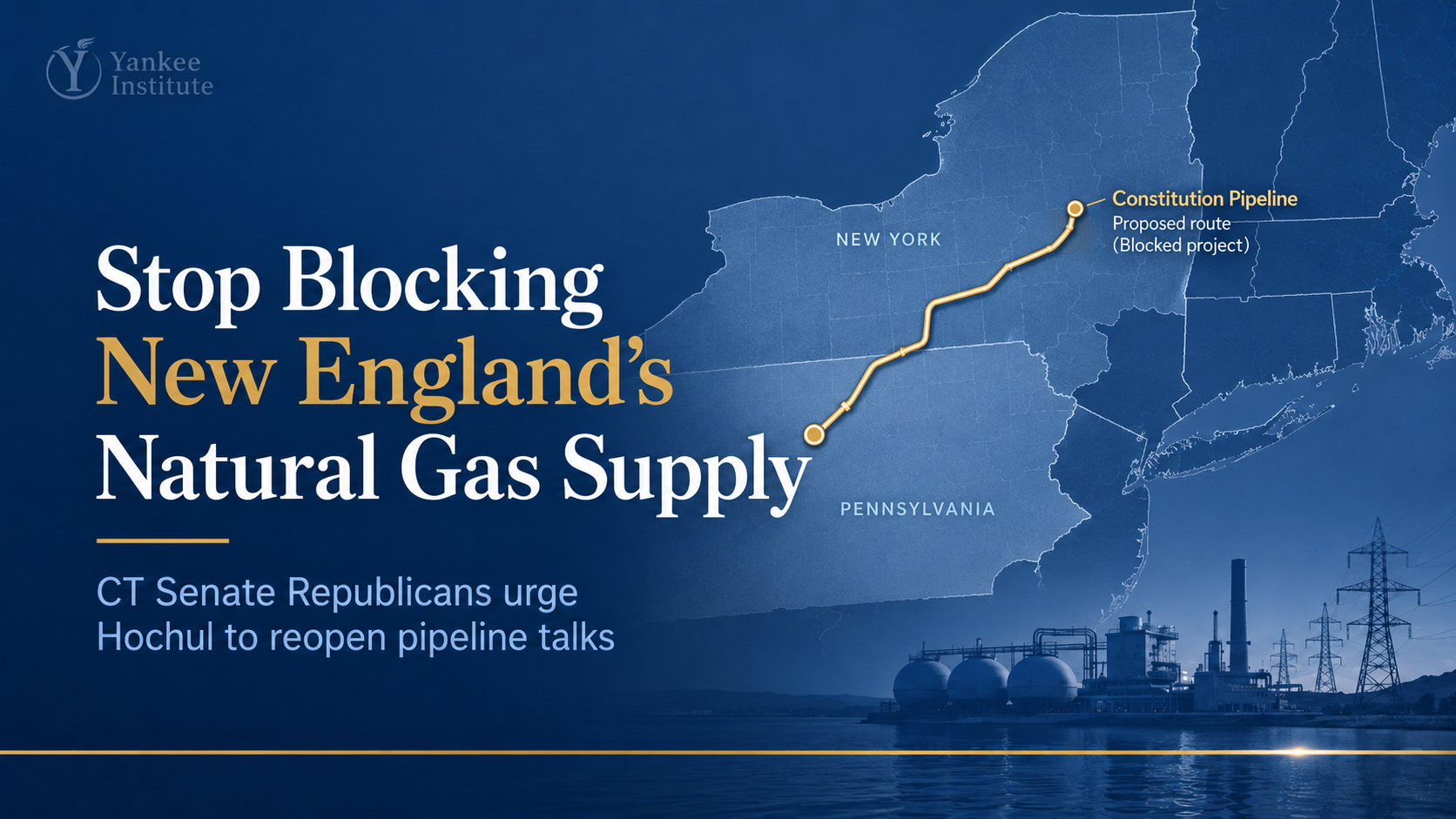
Connecticut Senate Republicans are asking New York Gov. Kathy Hochul to reconsider policies that have limited natural gas pipeline expansion into New England, arguing that decisions made across the state line are contributing to higher energy costs in Connecticut.
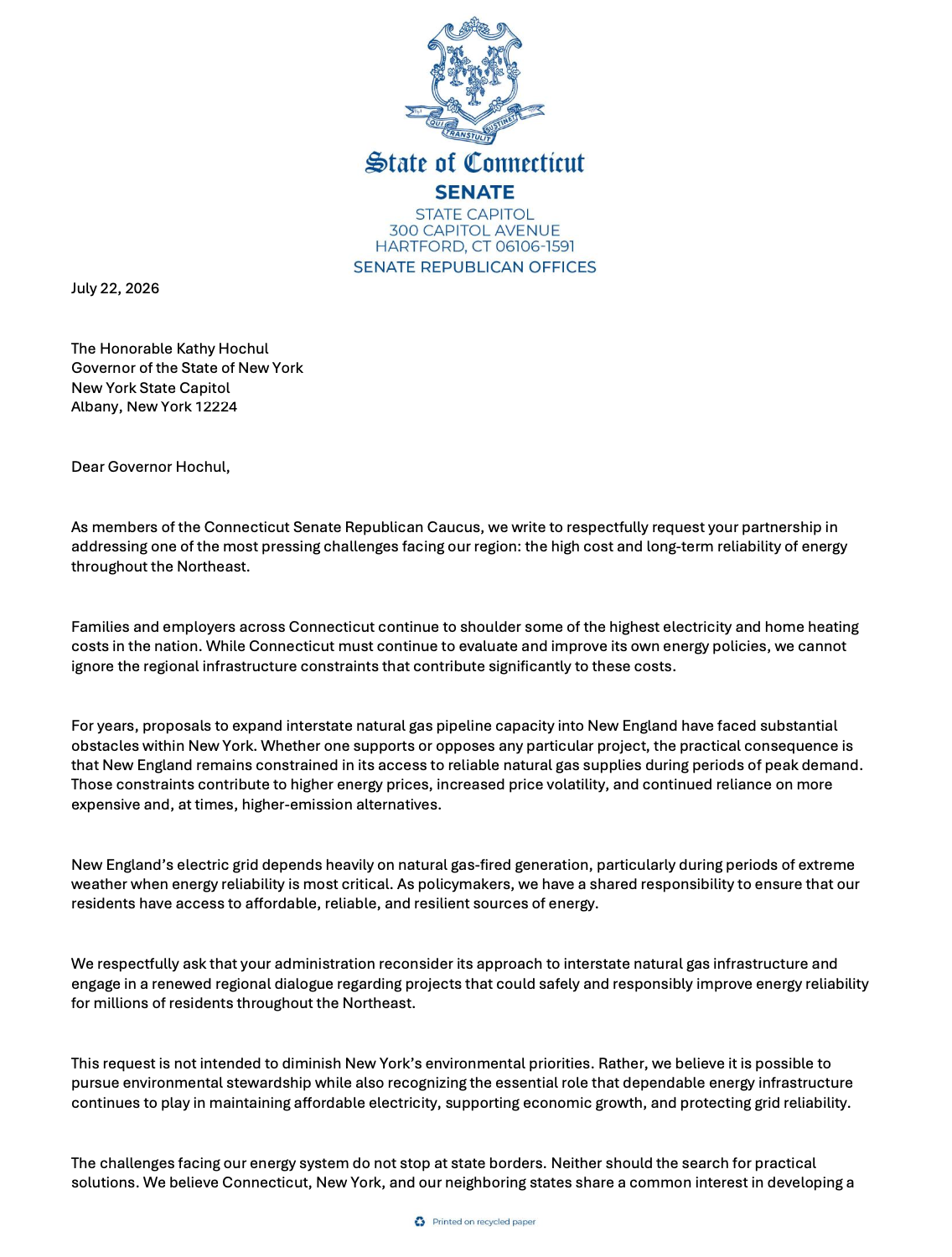
In a July 22 letter, seven Republican senators said Connecticut families and businesses continue to face some of the highest electricity and heating costs in the country while the region remains constrained in its access to natural gas.
According to U.S. Energy Information Administration data, Connecticut residential customers paid 27.37 cents per kilowatt-hour in May, nearly 49 percent above the national average.
The rate fell sharply after a temporary public benefits credit took effect May 1, cutting residential bills by roughly 14 percent, but Eversource is now seeking a separate rate increase that could raise the average residential bill by as much as 18 percent beginning in July 2027 if state regulators approve the full request.
“While Connecticut must continue to evaluate and improve its own energy policies, we cannot ignore the regional infrastructure constraints that contribute significantly to these costs,” the senators wrote.
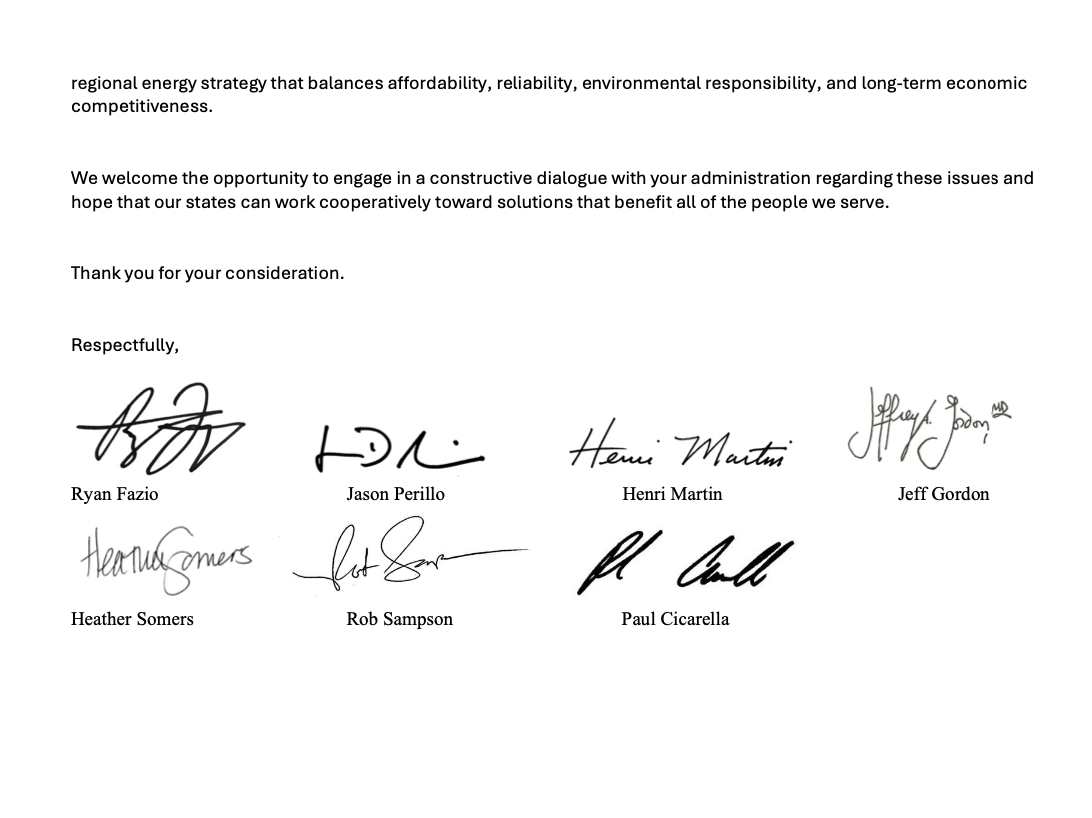
The letter was signed by Sens. Ryan Fazio (Greenwich), Jason Perillo (Shelton), Henri Martin (Bristol), Jeff Gordon (Woodstock), Heather Somers (Groton), Rob Sampson (Wolcott) and Paul Cicarella (North Haven).
Sampson said the letter is intended to open a broader discussion over regional energy policy. “We are reaching out in good faith to Gov. Hochul to say, ‘Hey, residents and businesses in both our states are being absolutely crushed by electricity costs. So, let’s talk about solutions. Let’s work together to address the crisis and do something about it,’” Sampson said. “We hope Gov. Hochul views this as a respectful request. We look forward to productive dialogue. Without it, the burdens on families and businesses in both our states will only continue to grow.”
A Regional Bottleneck
New England relies heavily on natural gas to generate electricity, but the region has limited pipeline capacity connecting it to major supplies elsewhere in the country. During extreme cold, natural gas is also needed for home heating, increasing competition for a limited supply and placing additional pressure on the electric grid.
Much of the dispute has centered on environmental permitting. New York regulators have used their authority under Section 401 of the federal Clean Water Act to deny or delay water-quality certifications needed for interstate pipeline projects, citing concerns about stream crossings, sediment and other construction impacts. A Manhattan Institute report found that New York has also used the permitting process as part of its broader effort to reduce carbon emissions, giving the state effective veto power over projects that have already undergone federal review.
The senators argued that New York has become a critical bottleneck. “For years, proposals to expand interstate natural gas pipeline capacity into New England have faced substantial obstacles within New York,” they wrote. “Whether one supports or opposes any particular project, the practical consequence is that New England remains constrained in its access to reliable natural gas supplies during periods of peak demand.” Those constraints, they said, contribute to higher prices, greater volatility and increased dependence on energy sources that can be both more expensive and more polluting.
An Invitation, Not an Ultimatum
The letter does not tie Hochul to a single project. Instead, it calls for a broader regional conversation on how New York and Connecticut can improve energy supply, reliability and affordability, an approach that gives Hochul room to move past years of pipeline disputes and work with a neighboring states on solutions aimed at lowering costs for families and employers across the region.
The letter also takes care to frame the request as compatible with New York’s environmental priorities, not opposed to them. “This request is not intended to diminish New York’s environmental priorities,” the senators wrote. “Rather, we believe it is possible to pursue environmental stewardship while also recognizing the essential role that dependable energy infrastructure continues to play in maintaining affordable electricity, supporting economic growth, and protecting grid reliability.”
The senators are not asking New York to approve every proposed pipeline. They are asking Hochul to recognize that environmental goals do not eliminate the need for reliable energy, particularly while renewable resources cannot yet meet the region’s electricity demand around the clock. They said the two states share an interest in developing a regional strategy that balances affordability, reliability, environmental goals and economic competitiveness. “The challenges facing our energy system do not stop at state borders,” they wrote. “Neither should the search for practical solutions.”
Whether Hochul accepts the invitation remains to be seen. But the senators’ message is straightforward: New England’s energy problems cross state lines, and solving them will require New York to come to the table.