Motor vehicle property tax bills were due July 1, with taxpayers generally given until Aug. 3 to pay without incurring interest. The bills arrived as lawmakers once again discussed eliminating a tax that is widely regarded in Hartford as regressive, confusing and unfair.
State Sen. MD Rahman (D-Manchester) recently wrote on social media that the issue is personal to him, recalling his struggle to pay taxes and insurance on his first car while earning minimum wage after immigrating to the United States. “That’s why I’ve introduced multiple bills to phase out the car tax while reimbursing towns for lost revenue,” Rahman wrote. “I will continue to propose them until we get this done for Connecticut families.”
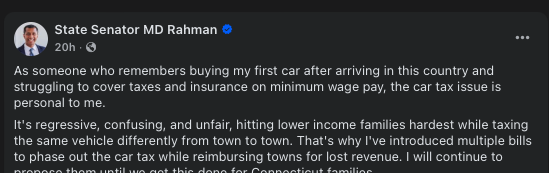
There is little reason to dispute Rahman’s criticism of the tax. Connecticut taxes the same vehicle differently depending on where its owner lives, and the burden falls disproportionately on lower-income households, which generally spend a greater share of their income on transportation.
But after years of proposals, task forces and public statements, taxpayers are entitled to ask a different question: is the legislature actually prepared to eliminate the tax? The record of the past two years suggests more energy has gone into describing the problem than into resolving it.
Rahman has already had a significant opportunity to develop a workable solution. He co-chaired the Motor Vehicle Property Tax Task Force, which was charged with studying the feasibility of repealing the tax, identifying replacement revenue and analyzing the effects on municipal budgets.
After seven meetings, the task force did not identify a sustainable replacement for the approximately $1 billion towns and cities collect annually from vehicle owners. Instead, it recommended allowing municipalities to eliminate the car tax and replace the lost revenue by taxing a larger share of the value of homes, businesses and other property. That is not tax elimination. It is a tax shift.
At the task force’s final meeting in February 2024, Capitol Region Council of Governments (CRCOG) Executive Director Matt Hart urged members not to approve the recommendations without additional work. He warned that allowing municipalities to set different assessment ratios could create administrative complications and new inequities among towns, and cautioned that shifting the burden onto real estate would increase pressure on homeowners already facing rising assessments, including those on fixed or lower incomes. Hart recommended that the General Assembly give the task force more time and resources to retain tax-policy experts capable of examining alternative models, measuring their effects and producing long-term revenue projections.
Rahman rejected the request. “We don’t want to go forward,” Rahman said. “We have a session starting tomorrow. So, I don’t think we really need to put more time in.” He instead described the task force’s proposal as a “very good option.”
Department of Revenue Services Commissioner Mark Boughton echoed Hart’s concerns. Boughton declined to endorse the report, warned of unintended consequences and said the task force had “not done their homework.” He urged lawmakers to engage tax experts and analyze how the proposal would affect each of Connecticut’s 169 municipalities.
Hart and Boughton were not defending the car tax. They were identifying what a credible repeal effort would require: outside expertise, detailed fiscal modeling, town-by-town analysis and a clear accounting of who would bear the cost instead. The task force had an opportunity to do that work. Its leaders chose not to continue it.
The legislature’s subsequent handling of car-tax bills followed a similar pattern.
In 2025, Reps. Steve Weir (R-Hebron) and Anne Dauphinais (R-Killingly) introduced House Bill (HB) 5449, which would have reduced the maximum motor vehicle mill rate from 32.46 mills to 30 mills and adjusted grants from the Municipal Revenue Sharing Fund to offset municipalities’ lost revenue. The bill would not have eliminated the car tax, but it offered measurable relief and identified a mechanism for keeping municipalities whole. Referred to the Planning and Development Committee, which Rahman co-chairs, it never received a public hearing.
Rep. Brandon Chafee (D-Middletown), who co-chaired the task force with Rahman, proposed an alternative through HB 5612: a uniform statewide vehicle property-tax rate, with the state collecting the revenue and redistributing it to municipalities based on their existing shares of car-tax collections.
The proposal would have addressed a legitimate problem by ensuring identical vehicles were taxed at the same rate statewide, but it would not have eliminated the tax so much as centralized it, requiring municipalities to cede control of a significant local revenue source. That proposal also did not receive a hearing.
Planning and Development later advanced Senate Bill (SB) 1445, which largely reflected the task force’s recommendation: allowing individual towns to exempt motor vehicles and replace the lost revenue by increasing the assessment ratio applied to homes, businesses and other taxable property. Municipal organizations warned this approach would simply transfer the burden to homeowners and businesses, and cautioned that wealthier towns with less reliance on vehicle-tax revenue might be able to eliminate the tax while municipalities that depend on it more heavily could not, deepening the town-to-town inequality lawmakers say they want to address. The bill cleared committee but never received a Senate vote.
SB 1554 also advanced from committee in 2025, proposing to phase out the vehicle tax alongside a state reimbursement mechanism for municipalities. It, too, died without a floor vote in either chamber.
Separately, Rahman introduced SB 700, which would have allowed municipalities to eliminate the car tax and temporarily increase taxes on real property to replace the lost revenue.
The Planning and Development Committee also briefly raised a 2025 proposal that would have increased the maximum motor vehicle mill rate before the measure was withdrawn, a reminder that the same committee promising relief was, at least momentarily, considering the opposite.
Connecticut’s car tax presents a genuine policy challenge. Towns and cities rely on the revenue to fund schools, public safety and municipal services, and repealing it without replacing the money would force either local spending cuts or increases in other property taxes.
That difficulty is precisely why serious analysis matters. Over the past two years, the legislature has commissioned a task force, introduced several competing proposals and repeatedly acknowledged the tax’s flaws. Yet an incremental reduction received no hearing. A statewide-rate proposal received no hearing. Broader phaseout bills died without floor votes. And when outside experts urged the task force to conduct further analysis before finalizing recommendations, its leadership declined.
Rahman is right that Connecticut families need relief. But relief requires more than acknowledging that the car tax is regressive. It requires lawmakers willing to pursue spending reforms, identify a credible replacement revenue source, or adopt a gradual reduction that municipalities can absorb. Until one of those paths is pursued seriously, proposals to eliminate the car tax will remain as recurring, and as inconclusive, as the tax bills themselves.