
Last week, Yankee Institute proposed the Expenditure Records and Information Notification Act, or ERIN’s Act, a reform requiring executive branch agencies to publish purchasing-card transactions in a centralized, searchable online database. The proposal was not inspired by one scandal. It was inspired by a system that keeps producing the same failures.
The review examined 15 recent Connecticut audit reports and special examinations that included purchasing-card findings. Nine reported that similar purchasing-card problems had appeared in previous audits.
The issue is no longer whether agencies occasionally violate purchasing-card policies. The issue is why the same deficiencies keep appearing years after auditors recommended corrective action.
The findings are remarkably consistent. Across multiple agencies, auditors repeatedly cited missing receipts, inadequate supporting documentation, unauthorized card users, untimely reconciliations, purchases lacking proper approval, split transactions and failures to comply with established policies. Different agencies, different employees, different administrations — many of the same weaknesses.
The Office of the Secretary of the State illustrates the problem. Auditors in 2019 found discrepancies between p-card logs and bank statements, late supervisory approvals and more than $24,000 in purchases for which supporting documentation could not initially be produced. They concluded that ineffective internal controls increased the risk of fraud, waste and abuse.
At Western Connecticut State University, auditors found unauthorized users making purchases, untimely reconciliations, inadequate documentation, improper payment of Connecticut sales tax despite the university’s tax-exempt status and potential conflicts of interest. More significantly, auditors noted that portions of the purchasing-card finding had already appeared in audit reports covering fiscal years 2009 through 2019.
Southern Connecticut State University produced a similar record. Auditors cited missing receipts, unauthorized users, missing authorization forms, purchases shipped to non-campus addresses and transactions split to avoid purchasing limits, and noted that similar deficiencies had appeared in each of the previous five audit reports.
A special review of executive leadership spending within the Connecticut State Colleges and Universities system in 2025 documented missing receipts, undocumented restaurant purchases, prohibited transactions, purchases exceeding policy limits and items delivered to personal residences.
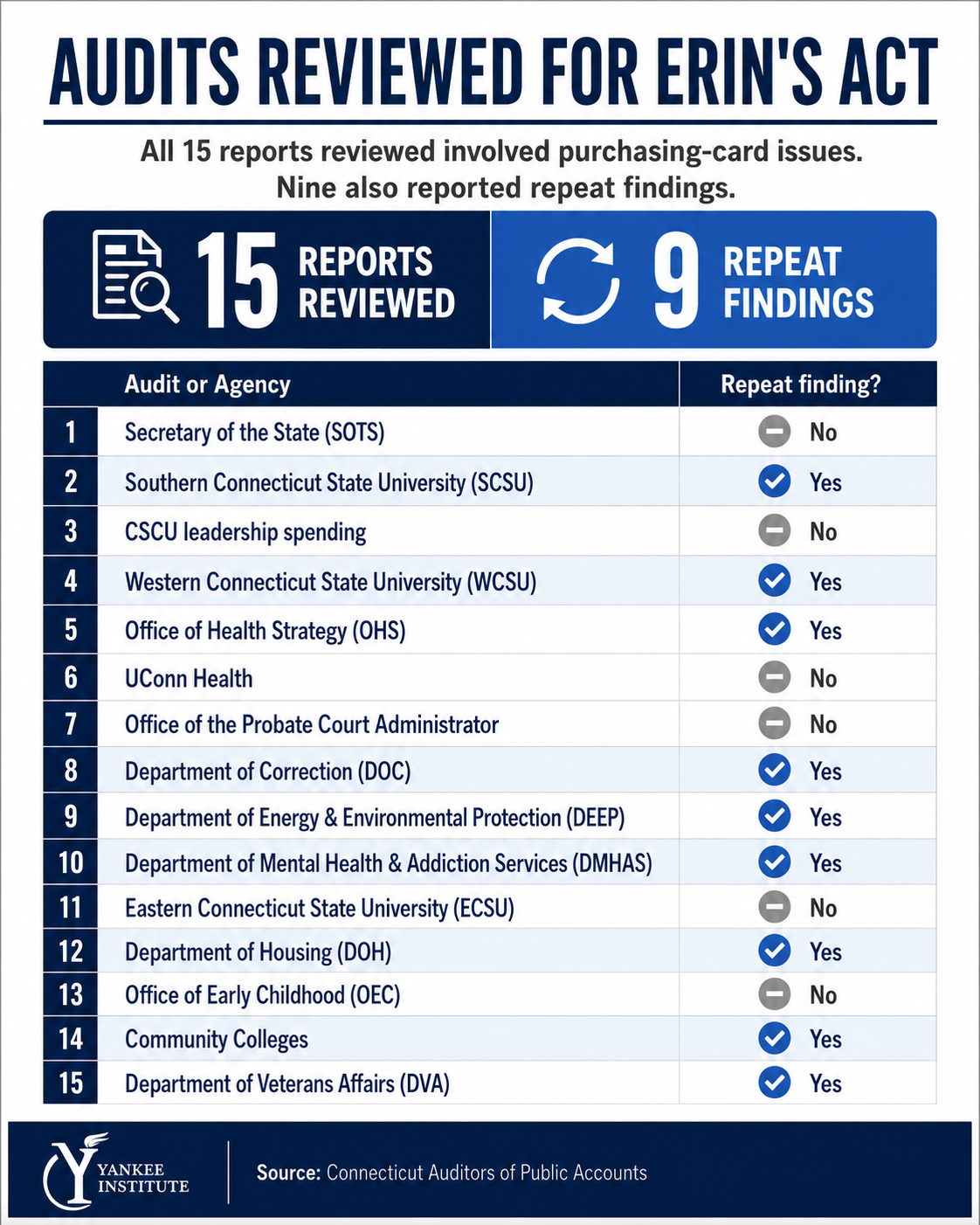
A first-time audit finding may reflect an isolated mistake. A repeat finding is evidence that the system failed to permanently correct the problem.
The answer should not be another training memo or another revision to an agency’s internal procedures. It should be state law.
Agency policies can be revised, reinterpreted, or allowed to lose emphasis as leadership changes. Commissioners retire. Governors leave office. A transparency requirement that exists only as internal policy can disappear just as easily as it was created. A statute establishes one statewide standard that every executive branch agency must follow, regardless of who occupies the governor’s office.
That is the purpose of ERIN’s Act.
The proposal has one central objective: make purchasing-card transactions public before they become audit findings.
ERIN’s Act would require executive branch agencies to publish purchasing-card transactions through a centralized public database maintained by the state. Each record would identify the cardholder, agency, vendor, transaction date, amount, business purpose and approving supervisor, along with an electronic copy of the receipt with confidential information appropriately redacted.
Agencies would not need to create new records to comply. Existing purchasing-card policies already require them to maintain most of this information. ERIN’s Act would make those records accessible to the taxpayers who paid for the purchases.
The proposal would not replace audits, nor should it. Auditors perform work the public cannot, evaluating internal controls, testing compliance and examining financial systems. But audits are retrospective. They tell taxpayers what happened after the money has already been spent. Public disclosure provides an additional layer of accountability before the next audit is written.
When taxpayers, legislators, journalists and watchdog organizations can routinely review purchasing-card transactions, agencies have a standing incentive to follow the rules already on the books. The goal is not merely to catch problems after they occur. It is to create conditions in which fewer problems occur in the first place.
Connecticut does not suffer from a shortage of purchasing-card policies. It suffers from a shortage of consequences for ignoring them.
State auditors have spent years documenting the same weaknesses. Agencies have received recommendations, revised procedures, and produced the same findings in the next audit cycle. The record suggests that internal accountability alone is not sufficient.
Lawmakers on both sides of the aisle should be able to agree on a straightforward principle: when public employees spend taxpayer money, taxpayers should be able to see the receipts. ERIN’s Act would give them that ability and give agencies one more reason to ensure the next audit contains fewer repeat findings than the last.