
Gov. Ned Lamont secured the Connecticut AFL-CIO’s endorsement last month after candidate interviews conducted behind closed doors. Now, one of the federation’s state employee affiliates is already organizing members around the priorities it hopes to advance in the next State Employees Bargaining Agent Coalition (SEBAC) negotiations with the Lamont administration.
CSEA SEIU Local 2001 is both an affiliate of the Connecticut AFL-CIO and one of the unions that participates in SEBAC, the coalition that negotiates statewide pension and health benefits on behalf of tens of thousands of Connecticut state employees. The current SEBAC retirement and health agreement expires in June 2027.
In a July 1 post titled “SEBAC News,” CSEA announced that nearly 300 stewards, leaders and delegates from across SEBAC gathered “to kick off the next major fight over pensions, healthcare and the future of public service in Connecticut.” The union laid out several issues it says members should organize around before negotiations intensify:
- Fixing Tier IV pensions.
- Protecting healthcare for active employees and retirees.
- Strengthening hazardous-duty retirement benefits.
- Defending telework.
- Keeping public service careers attractive to future workers.
Those priorities are not entirely new. In December 2024, SEBAC argued Connecticut should “protect and enhance” pension and healthcare benefits to improve recruitment and retention, and disclosed that it had begun informal discussions with the Lamont administration well before the 2027 contract expiration to address what it called “the inadequacies in current benefits offered to newer employees.” The recent CSEA update suggests those conversations are now being paired with broader member organizing.
Tier IV Back in the Spotlight
Perhaps the most significant priority is Tier IV.
Created under the 2017 SEBAC agreement negotiated during Gov. Dannel Malloy’s administration, Tier IV was designed to reduce the long-term cost of retirement benefits for newly hired state employees. The hybrid retirement plan combined a traditional defined-benefit pension with a defined-contribution account while requiring new employees to contribute more toward their retirement benefits than workers in earlier pension tiers.
When lawmakers approved the agreement, they described Tier IV as a structural reform that would help bend Connecticut’s long-term cost curve rather than simply produce short-term budget savings. In an August 2017 opinion piece defending the agreement, Senate Majority Leader Bob Duff (D-Norwalk) wrote that the broader SEBAC deal would save taxpayers approximately $24 billion over 20 years and “completely restructure Connecticut’s pension system for the future.” He argued the new retirement tier would move more than 10,000 future employees into a less expensive pension plan years earlier than would have otherwise occurred.
Less than a decade later, CSEA has identified “fixing Tier IV” as one of its top organizing priorities for the next round of negotiations. The union argues the pension multiplier is too low and that Tier IV’s risk-sharing provision requires newer employees to shoulder too much of the pension system’s financial risk.
CSEA has not publicly released detailed bargaining proposals, and the Lamont administration has not indicated whether it would support changes to Tier IV. But if Tier IV was promoted as a long-term structural reform intended to generate billions in taxpayer savings, the next round of negotiations could test whether those savings remain a priority. Whether the state preserves the original framework or agrees to modify it will ultimately determine how much of the 2017 reform remains intact.
More Than Pensions
Pensions are only one part of what the union says it wants to discuss.
CSEA also lists healthcare as a major priority, arguing that rising medical costs make it important to protect benefits for both active employees and retirees. Telework has also become a bargaining issue. The union says remote work has improved productivity, reduced commuting time, stabilized staffing and made state service more accessible, and argues it should be handled through collective bargaining rather than left solely to management discretion.
That position contrasts with developments elsewhere. Earlier this year, California Gov. Gavin Newsom directed most state employees to return to the office at least four days a week, saying in-person work would strengthen collaboration, accountability and public service. Connecticut’s unions are signaling they hope telework remains part of the next bargaining conversation.
Hazardous-duty retirement benefits round out the union’s list of priorities, with CSEA arguing employees in high-risk jobs deserve stronger retirement protections.
The Message Is Reaching Members
The emphasis on Tier IV is not limited to union leadership.
In a 2024 notice to members, the Administrative & Residual Employees Union (A&R) republished a SEBAC statement criticizing the Tier IV risk-sharing provision after newer employees were required to make an additional 2 percent pension contribution when the pension fund failed to meet its investment benchmark. The statement said SEBAC opposed the surcharge, linked it to recruitment and retention concerns, and predicted the provision would “likely be an issue in the 2027 pension and healthcare negotiations.”
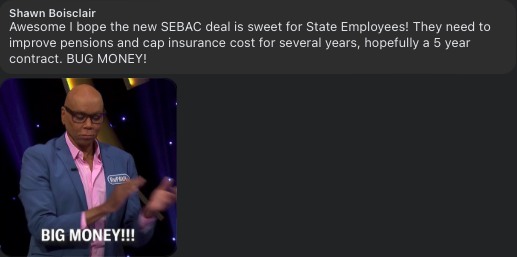
That message appears to be resonating with at least some members. After Yankee Institute published an article examining Gov. Ned Lamont’s endorsement by the Connecticut AFL-CIO and asking what organized labor might expect in return, Shawn Boisclair, a Connecticut Department of Transportation fiscal and administrative manager in the P-5 bargaining unit, responded in the article’s comment section: “I hope the new SEBAC deal is sweet for State Employees! They need to improve pensions and cap insurance cost for several years, hopefully a 5 year contract. BIG MONEY!”
Boisclair’s comment does not represent an official bargaining position of SEBAC, A&R, CSEA, the Department of Transportation, or the Lamont administration. But its placement is notable, offered in direct response to an article asking what labor hoped to gain from the endorsement, and it echoes the same themes union leaders have already identified publicly: improving Tier IV pensions and limiting employees’ healthcare costs.
What Comes Next
None of the union’s priorities guarantees a place in a final SEBAC agreement, and the Lamont administration has not publicly committed to any of them. But the direction of the conversation is becoming clearer.
The AFL-CIO endorsement is complete. SEBAC-affiliated unions are organizing members around pensions, healthcare, telework, hazardous-duty benefits and changes to Tier IV. Individual state employees are beginning to speak publicly about what they hope the next contract will deliver.
The negotiations themselves will largely occur behind closed doors. The unions, however, have already begun telling their members what they hope to achieve once bargaining begins.