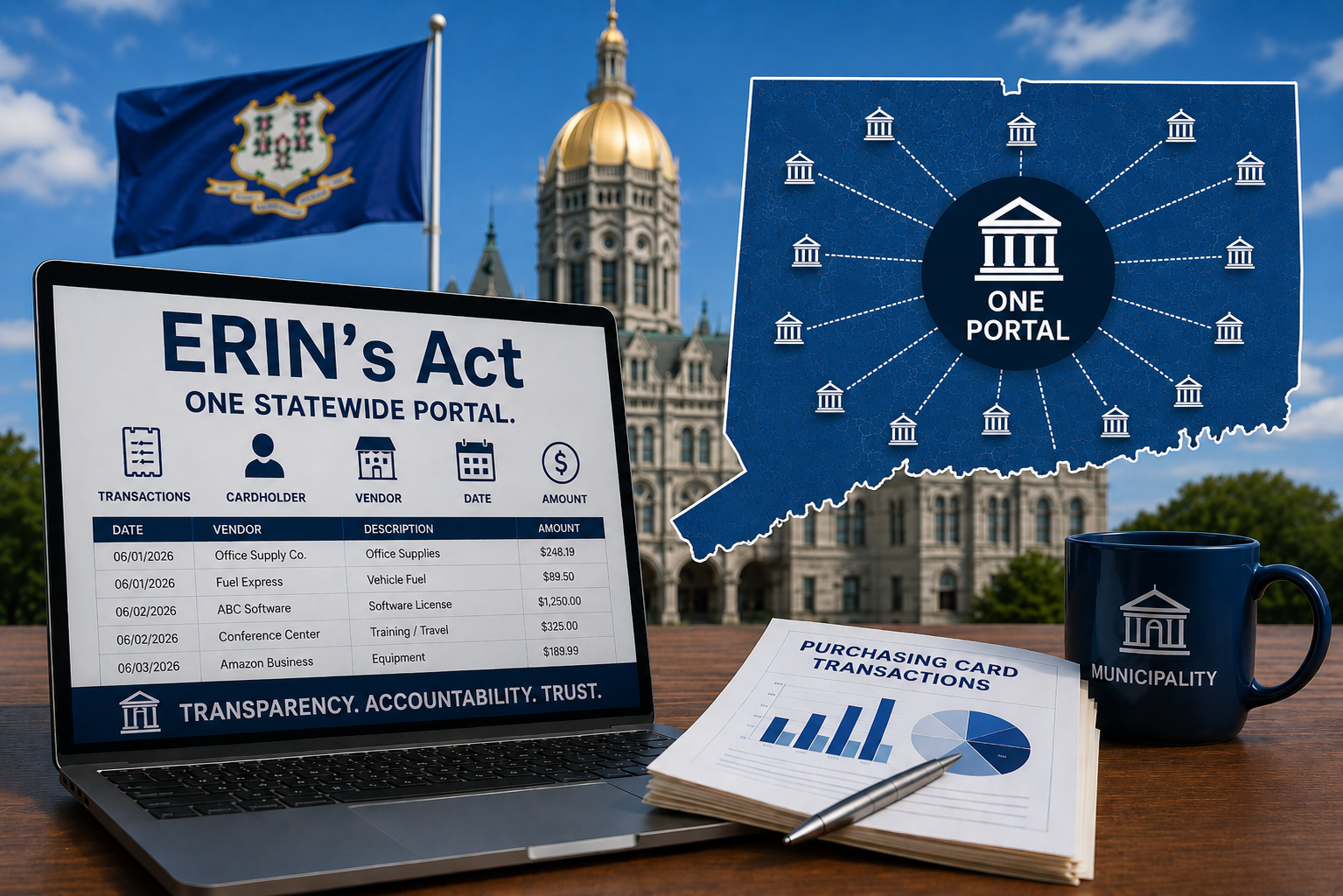
In June, Yankee Institute proposed ERIN’s Act, a legislative framework to make state government purchasing-card transactions and receipts publicly searchable through a centralized online portal. The idea is simple: make spending visible before questionable purchases become tomorrow’s audit findings.
Last week, State Comptroller Sean Scanlon and Deputy Comptroller Tara Downes took a meaningful step in that direction.
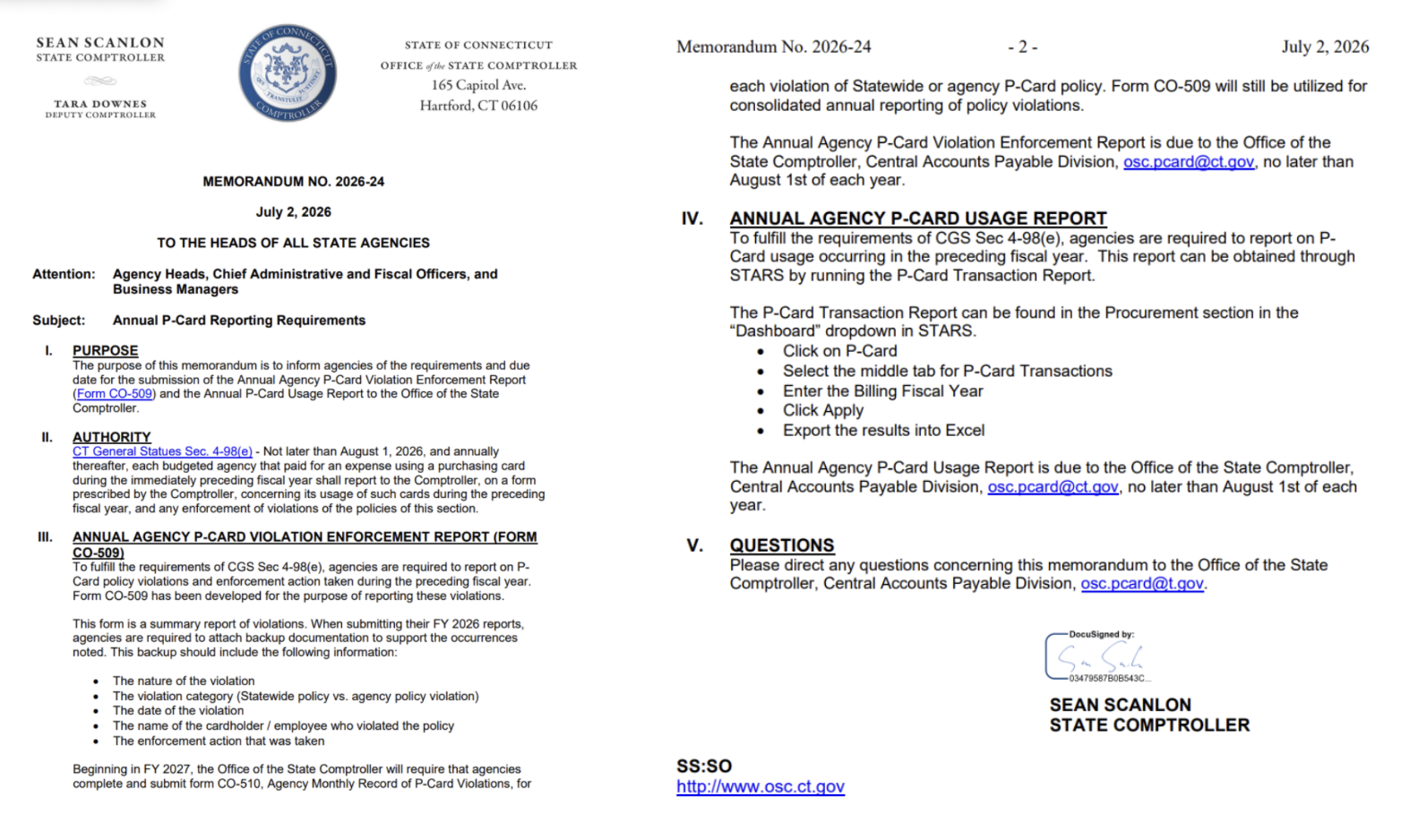
In a July 2 memorandum to state agencies, the Office of the State Comptroller issued guidance implementing the reporting requirements established in Connecticut’s 2025 government accountability law, which requires agencies to submit their first annual purchasing-card usage and policy-violation reports by Aug. 1, 2026.
The law requires agencies to report purchasing-card use and policy violations. The Comptroller’s memo gives agencies a clear roadmap by requiring them to identify each violation, document the employee involved, describe any enforcement action taken and include supporting documentation. Beginning in fiscal year 2027, agencies also must maintain a monthly record of every purchasing-card violation.
The Comptroller’s Office deserves credit for moving quickly to implement the law. Rather than leaving agencies to interpret the new requirements on their own, the memo establishes a consistent reporting process that should strengthen oversight statewide. It also raises an obvious question: If stronger purchasing-card oversight is good policy for state agencies, why shouldn’t taxpayers expect the same transparency from local government?
Connecticut’s 169 municipalities operate purchasing card programs to buy everything from office supplies and fuel to software, travel and emergency equipment. Taxpayers don’t care whether questionable spending occurs in Hartford, New Britain or their own town hall. They expect the same accountability wherever their money is spent.
The question is how to extend that transparency without creating another unfunded state mandate.
The answer is not to require every municipality to purchase software, hire staff or build its own transparency website. Connecticut should instead create a single statewide portal that municipalities can use at no cost. Towns would upload records they already maintain: cardholder, vendor, transaction date, amount, business purpose, approving supervisor and receipt, with confidential information already protected under Connecticut law, such as credit-card numbers and bank account details, properly redacted.
This approach builds on what the Comptroller is already doing rather than replacing it. State agencies now report purchasing-card activity and violations to the Comptroller. ERIN’s Act would take the next step: making those transactions publicly searchable, while allowing municipalities to report through the same statewide system instead of building one of their own.
That design also addresses the strongest criticism likely to be raised against extending ERIN’s Act to towns, that it would burden local governments with new work and additional costs.
It wouldn’t. Municipal finance offices already reconcile purchasing-card statements, collect receipts and retain documentation for auditors. Most card providers already generate electronic transaction reports that export directly into Excel. ERIN’s Act would not require towns to create entirely new records. It would require them to upload records they already keep into a system the state maintains.
The rollout could be phased. Larger municipalities with substantial purchasing-card activity could participate first, followed by mid-sized communities and then smaller towns. Communities with only a handful of cards or minimal annual spending could receive simplified requirements. The goal is meaningful transparency, not unnecessary paperwork.
Some will argue that audits already provide sufficient oversight. They don’t. Audits occur months or years after money is spent, examine only a sample of transactions and cannot realistically review every purchase by every cardholder. Public disclosure changes the equation by allowing taxpayers, reporters and elected officials to identify questionable spending before it becomes an audit finding.
Connecticut has already seen why that matters. The investigation into former New Britain Mayor Erin Stewart’s purchasing card became one of the state’s highest-profile municipal spending controversies. Fairfield launched an outside investigation after questions arose over town credit-card purchases. New Haven fired an employee who admitted making unauthorized purchases on a city card. Other municipalities have grappled with missing receipts, weak documentation and inadequate internal controls. The facts differ from case to case, but the pattern is consistent: taxpayers usually learn about questionable purchases only after an audit, investigation or whistleblower complaint.
Those investigations are expensive. New Britain alone has incurred more than $102,000 on outside legal and investigative work related to the purchasing-card investigation as of early July, with additional costs expected as the review continues. Earlier transparency cannot guarantee every misuse would be prevented, but it gives supervisors, taxpayers and elected officials a better chance of identifying questionable spending before it grows into a six-figure investigation.
The economics favor transparency. Every Freedom of Information request consumes staff time. Every outside investigation costs money. Posting purchasing-card transactions online each month is almost certainly cheaper than investigating questionable spending after the fact.
Connecticut already embraces this principle through Open Checkbook, which allows taxpayers to search state expenditures online. ERIN’s Act applies that same philosophy to one of government’s least transparent spending tools, and extends it beyond Hartford to local government.
The Comptroller’s new reporting requirements are a strong first step because they strengthen oversight inside government. ERIN’s Act adds the missing piece by making purchasing-card spending visible outside government, to the taxpayers who paid the bill.
Done correctly, municipalities would not have to build anything. They would simply use a system the state already provides.
Government purchasing cards are funded by taxpayers. Taxpayers shouldn’t need an audit, a whistleblower or a Freedom of Information request to see how that money was spent. They should only need to open a webpage.