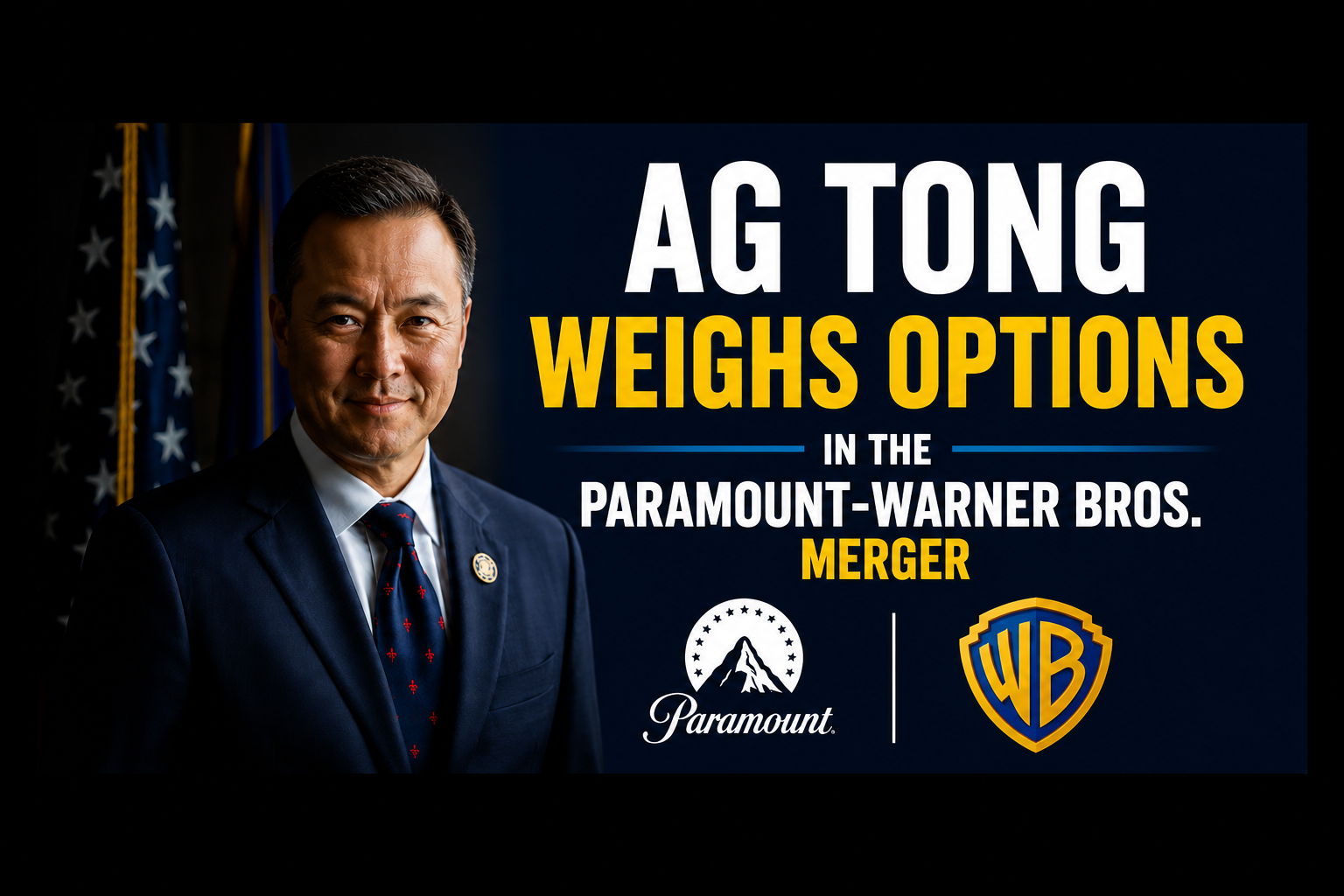
The proposed acquisition of Warner Bros. Discovery by Paramount Skydance would bring together CBS, Paramount Pictures, Paramount+, Nickelodeon, Warner Bros. Pictures, HBO, CNN, Discovery Channel and the Max streaming service under a single corporate roof.
Supporters say the roughly $110 billion deal would help two legacy media companies scale up to compete with Netflix, Amazon, Apple, YouTube and Disney. Critics warn it could mean fewer theatrical releases, fewer jobs, less competition and accelerating consolidation across entertainment and news.
Connecticut Attorney General William Tong is among the state attorneys general now weighing those concerns.
Tong’s office confirmed it received an April 2 letter from Cinema United President and CEO Michael O’Leary urging Tong and South Dakota Attorney General Marty Jackley to scrutinize the transaction and consider moving to block it.
O’Leary pointed to Disney’s acquisition of 20th Century Fox as a cautionary example: the two studios combined for 26 wide releases in 2016 but only 14 last year — a 46 percent decline — while 20th Century Fox titles generated roughly $1 billion less in revenue last year than in 2016, a nearly 70 percent drop.
Tong responded with a statement of concern. “I have serious concerns about the consequences of this merger for consumers, local theaters and the workers and communities that rely on them, and actors and artists in our country’s celebrated film industry, as well as Paramount’s impact on quality, objective and independent news,” he said. “I am evaluating all options in coordination with our multi-state partners.”
That last line matters. State attorneys general can challenge transactions they believe violate antitrust law, and coordinating with multi-state partners means Tong’s office could have a direct role in determining whether the deal proceeds, faces conditions or becomes entangled in litigation.
Organized labor has also pressed for intervention. The International Brotherhood of Teamsters urged the U.S. Department of Justice to oppose the merger unless the companies agree to enforceable worker protections, domestic production commitments, strong labor standards and guarantees against layoffs or erosion of union jobs. The union warned the deal could threaten nearly 15,000 Motion Picture Teamsters.
Together, Cinema United and the Teamsters represent the strongest public case against the transaction: fewer films, fewer theater jobs, fewer consumer choices and more leverage concentrated in a combined Paramount-Warner.
A different argument comes from Bill Lockyer, a Democrat who served as California attorney general from 1999 to 2007 and previously served as president pro tempore of the California Senate. In a recent Hollywood Reporter op-ed, Lockyer argued that the deal deserves a “careful and rigorous review grounded in facts, market realities and established antitrust principles,” while warning that “careful review is not the same as presumptive opposition.”
Lockyer’s point is that regulators should evaluate whether the merger would actually reduce competition in today’s market, where traditional studios are no longer competing only with one another.
Paramount Skydance and Warner Bros. Discovery now compete against global technology platforms and streaming services with enormous financial resources, diversified revenue streams and worldwide reach. A combined HBO Max and Paramount+, he argues, could produce a stronger competitor capable of investing in content and distribution at scale — and that financially stable studios are better positioned to green light projects and support long-term employment than companies struggling to stay solvent.
The Teamsters’ position also illustrates how the debate has expanded beyond traditional antitrust analysis — it is seeking enforceable labor guarantees as a condition of approval. That raises a legitimate question about scope: is antitrust review about protecting competition, or has it become a vehicle for securing concessions that go beyond that mandate?
The broader market context complicates the anti-merger case. Americans are leaving cable forstreaming, and the dominant players are no longer legacy Hollywood studios — they are global technology companies with audiences, balance sheets and content budgets that dwarf whattraditional media can marshal.
A combined Paramount-Warner would still compete against Netflix, Amazon, Apple, Disney,Comcast/NBCUniversal, Sony, Fox and a growing list of digital rivals. That makes this look less like amonopoly in the making than two legacy companies trying to avoid irrelevance.
None of that makes the merger risk-free. Consolidation in both entertainment production and news distribution warrants genuine scrutiny. But if state attorneys general move to challenge the deal, they should be prepared to explain specifically how consumers would be harmed in a market already dominated by larger competitors — not simply that consolidation is concerning in the abstract.
Connecticut residents should want their attorney general asking hard questions about a transaction of this size. They should also expect those questions to be answered with evidence. The public case for scrutiny is clear. The public case for blocking the merger outright is considerably less so.