


Former Hartford Mayor Luke Bronin surprised many Connecticut political observers by defeating Congressman John Larson for the Democratic convention endorsement in Connecticut’s 1st Congressional District, setting up an August primary and drawing attention to an emerging divide within the state’s organized labor movement.
That divide became visible in a public social media exchange between Logan Williams, a communications assistant at AFSCME Council 4, and Brian Anderson, a retired AFSCME Council 4 lobbyist, following Bronin’s endorsement victory. AFSCME Council 4 represents roughly 30,000 to 35,000 active and retired members across state and local government, school boards, and portions of the private sector, making it one of Connecticut’s largest unions.
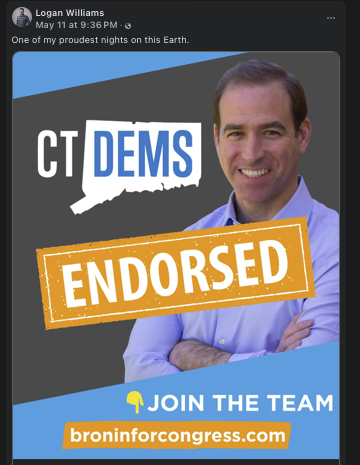
After Bronin secured the endorsement, Williams posted on Facebook calling it “one of my proudest nights on this Earth.” Anderson responded by questioning why Democrats would celebrate defeating a congressman with a longstanding record of supporting labor priorities.
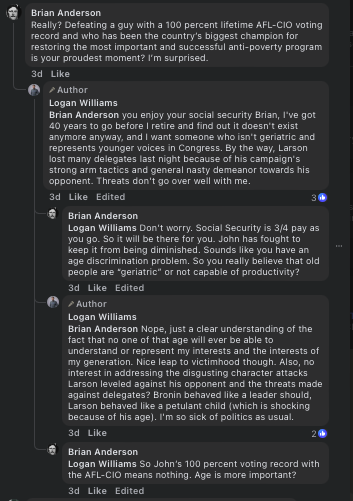
“Really?” Anderson wrote. “Defeating a guy with a 100 percent lifetime AFL-CIO voting record and who has been the country’s biggest champion for restoring the most important and successful anti-poverty program is your proudest moment? I’m surprised.”
Williams framed his reply in generational terms. “You enjoy your social security Brian,” he wrote. “I’ve got 40 years to go before I retire and find out it doesn’t exist anymore anyway, and I want someone who isn’t geriatric and represents younger voices in Congress.”
Anderson challenged that framing, arguing that Larson had spent years defending Social Security and raising concerns about Williams’ characterization of older workers. “Sounds like you have an age discrimination problem,” he wrote. “So, you really believe that old people are ‘geriatric’ or not capable of productivity?”
Williams rejected that characterization while maintaining his position. “Nope, just a clear understanding of the fact that no one of that age will ever be able to understand or represent my interests and the interests of my generation,” he wrote.
Williams also alleged that Larson’s campaign employed “strong arm tactics,” a “general nasty demeanor,” and “threats” toward delegates during the convention process, contrasting what he described as Bronin behaving “like a leader” with Larson behaving “like a petulant child.” Those characterizations reflect Williams’ perspective and have not been independently verified.
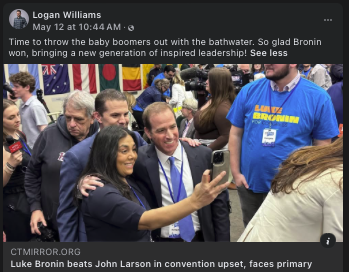
Roughly twelve hours later, Williams added a separate post: “Time to throw the baby boomers out with the bathwater. So glad Bronin won, bringing a new generation of inspired leadership.”
The exchange surfaces a broader tension that has become increasingly apparent within organized labor and Democratic politics nationally, namely, how much weight institutional loyalty and voting records should carry relative to questions of generational representation and political style.
Larson has a long record as a congressional ally of organized labor. The reaction to his convention loss, however, suggested that for at least some younger labor activists, that record may not be sufficient insulation against primary challenges from within the coalition.
The exchange also illustrated how internal political disagreements can shift quickly from policy substance to more personal terrain. Rather than focusing on competing legislative records or policy positions, much of the exchange centered on age, personality, and dissatisfaction with longtime incumbents.
How those competing arguments resonate with Democratic primary voters will become clearer as the August contest approaches. The Bronin-Larson race raises questions that extend beyond Connecticut: whether longstanding labor alliances retain their political force, and how Democratic coalitions navigate the tension between institutional relationships and demands for generational change.