


At least four Connecticut legislators changed their votes on a homeschool regulation bill on March 18, switching from “no” to “yes”, reversing the outcome and allowing the measure to advance the bill out of the Education Committee.
What had initially appeared to be a failed vote ultimately became a passage, prompting a national homeschool legal organization is now asking a straightforward question: what happened?
The legislation at the center of the dispute, House Bill 5468, is a 19-page proposal that would impose new requirements on families who withdraw a child from public school.
Under current Connecticut law, parents have broad discretion to homeschool, with relatively limited administrative involvement. HB 5468 would significantly alter that framework.
Most notably, the bill would require that any parent withdrawing a child from public school be automatically referred to the Department of Children and Families (DCF), regardless of the reason. The withdrawal could not be finalized without DCF approval. The proposal also introduces additional layers of oversight, shifting what is currently a private parental decision into a process subject to routine government review.
The bill drew substantial opposition from parents and stakeholders.
Thousands of individuals submitted testimony or spoke at public hearings against the proposal, while only s small number, 50, voiced support. Concerns were also raised by state agencies and local officials.
In written testimony, the Department of Children and Families warned that the bill would create new reporting requirements and caseload demands that would be “impossible to process at current staffing levels.” School superintendents similarly cautioned that the added responsibilities would exceed district capacity.
By most measures, the proposal faced broad resistance and limited institutional support.
That makes what happened next notable.
During the March 18 committee meeting, members debated the bill before taking a roll call vote. The initial tally appeared to defeat the measure.
As is standard practice, the voting window remained open for a period of time to allow members to adjust or record their votes.
By the time the vote was finalized, the outcome had changed.
According to a press release from Attorney Deborah G. Stevenson of the National Home Education Legal Defense, a review of the official vote sheet indicated that at least four votes originally recorded as “no” had been changed to “yes,” with white-out used to revise the entries. Those changes determined the bill’s advancement.
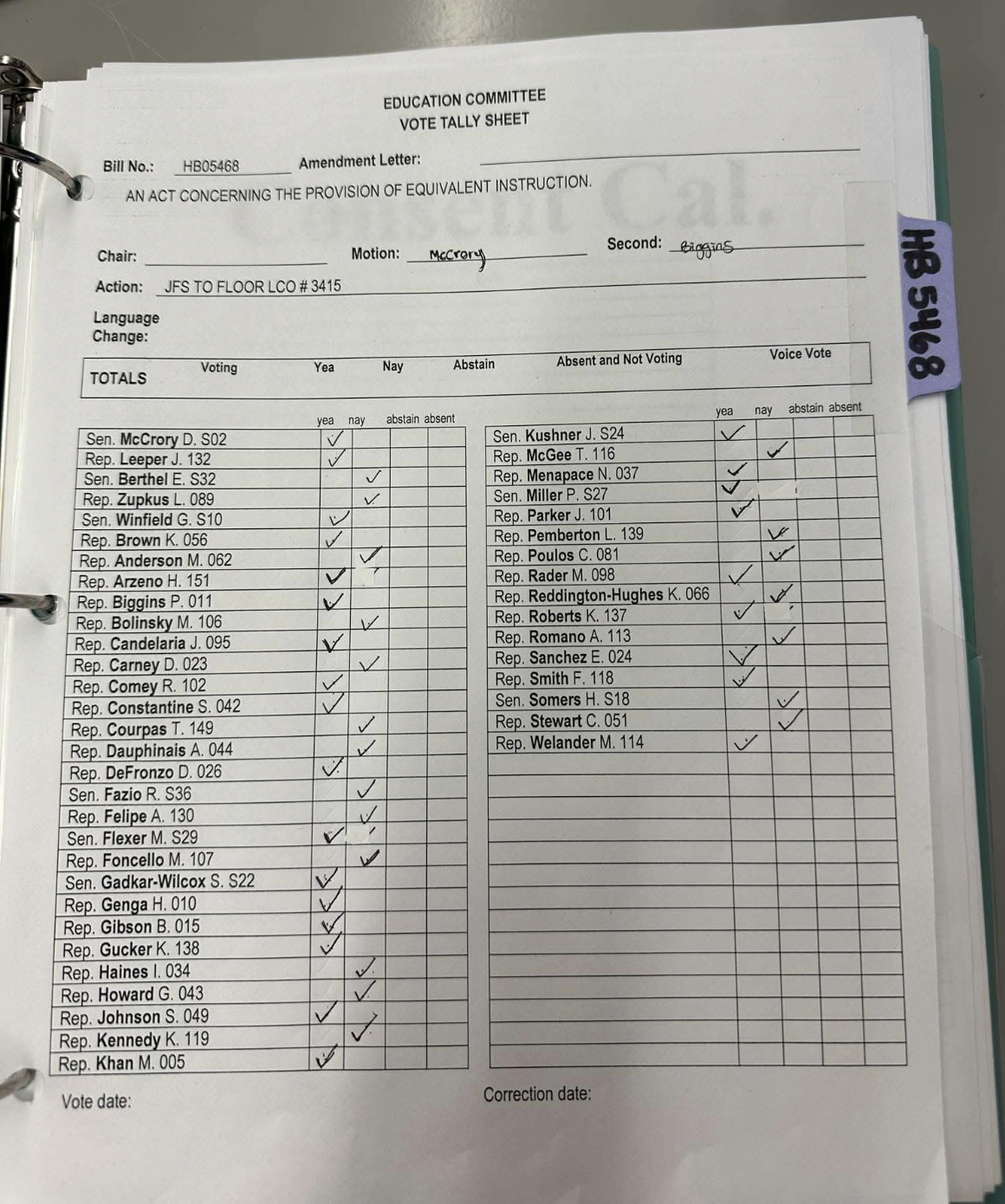
The organization does not allege wrongdoing and acknowledges that legislators are permitted to change their votes.
However, it is seeking clarification about the circumstances under which those changes occurred, including whether legislators were contacted during the voting window or faced external pressure to reconsider their positions.
The group notes that similar concerns have been raised in past legislative debates involving close votes, though it does not assert that such pressure occurred in this instance.
For many families, the issue is not limited to legislative procedure.
HB 5468 represents a significant shift in state policy toward homeschooling. Automatic referral to DCF based solely on a decision to withdraw a child from school marks a departure from existing practice and raises broader questions about how homeschooling families are treated under state law.
Given the level of public engagement, attention has increasingly focused on both the substance of the proposal and the process by which it advanced.
The bill will now continue through the legislative process.
But for those closely following the issue, the immediate question remains: how did a vote that appeared settled ultimately changed — and will a clear explanation will be provided?